Tips for Walkway Designs
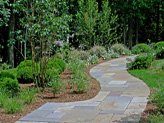
Walkway designs can be very creative. Here is some professional information along with some walkway pictures to help you with your design. Some ideas to consider when designing is the shape, design, width and materials. Also, there are certain things that will determine the cost of the walk. These are size (square footage), paving materials, and any steps that may be necessary.
Take a look at my list of hardscape choices at the bottom of the page.
Even if you go with a less expensive material, if the design is
beautiful, the walk will be impressive.
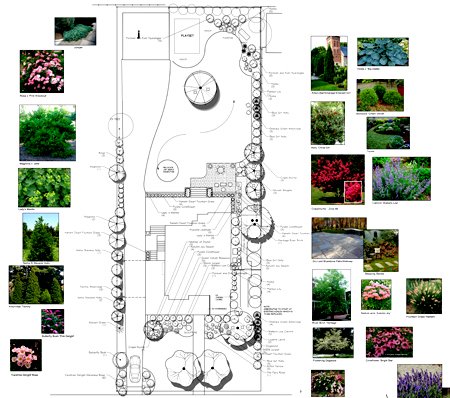
Take a look at my affordable packages of landscape designs!
(I have sold many and homeowners lover them.)
Walkway Designs and Shapes
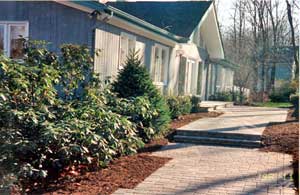
The geometry of your walkway can be either curvilinear or straight.
This is usually determined by the locations and relationships of the places that the walk is connected. For example, if the walk is to be a short one, forming a connection
from the street to the front door, curves may not be possible.
Straight paths have more of a directness about them. Yet the widths of the geometry can change and create interest.
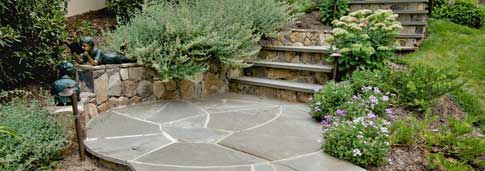
Walkways might have steps and landings in steep areas. Rather than
creating a plain landing, change the shape, width or design to make it
interesting.
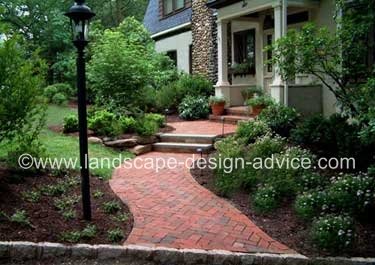
Curved walkways will provide a meandering feeling and create a more naturalistic feeling. One or more curves may make up the walk. If your garden walkway is coming off a front porch, start off with lines that are perpendicular to the porch. You can then start the curve; the walk can be one large curve or it can have a few curves with "switchbacks".
You might also have to consider including steps in the walk. I have written another page addressing landscape steps, materials and other bits of practical information.
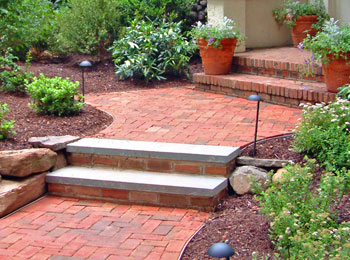
Would you like to know what this paver walkway costs? Just click the link here. You will also see the "before" of this project!
Widths
Depending on the importance of the walk, it might be wide or narrow. Front walks and those that are main access ways should be a minimum of 4 feet wide. They can be much wider too. If you have the room and a wider walk fits with the scale of your surroundings, I would consider it.
Less important garden walkways can be 3 feet wide. These might be those that lead from the driveway to the backyard landscape. Minor paths can be as narrow as 2 feet. Stepping stones can be even smaller.
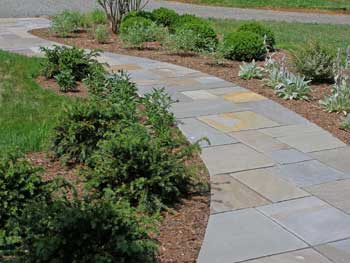
If using stepping stones such as irregular pieces of bluestone, consider planting low growing plants, such as Thyme or Sedum, in between the stones for a very casual and natural look. These might be pathways that are necessary. They also might be ones that lead further back into your backyard landscaping, such as a sitting area, woods, shed, etc.
Take a look at some walkway pictures and how I used them in my landscape projects.
Ebook
Designing Front Yards
Learn some great tips on how to create a front yard design that will really be unique and special!
- Professional tips on how to landscape your front yard.
- Eliminate confusion about front foundation plants.
- Learn about plant placement.
- And much, much more.
You will find out about all that and more.
Materials
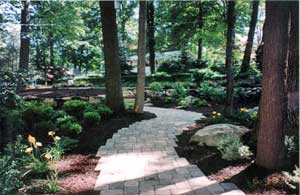
The material should go well with material on your house. Expense is often a consideration. You can visit my page on paving costs for more specific pricing information.
More Paving Information
Bluestone - more about this great material (one of my favorites)
Stone Paths - casual and inexpensive ideas.
Travertine pavers or Travertine Stone
Brick Walkway Designs - patterns and pictures
How To Fix Slippery Brick Problems - causes and solutions
Concrete pavers - helpful information
Concrete Walkways - see different creative ideas.
Decomposed granite - there are three different applications for this material with varying costs.
If you are undecided about which paving material to use, see these pages!
Landscape Design Services by Susan
(Click for details)
For Clients in All Areas of the U.S. and Canada
Professional Package of Ready Made Front Yard Designs
(Click for details)
The More Affordable Option
If you enjoyed this page, please share it!