Trench Drains
For Driveways, Walks, and Patios

Trench drains are similar to perforated pipes in that they allow water to enter into a pipe so that it can be lead elsewhere. They can be used at the edge of hardscapes where it's difficult to direct water to another place, grade the land or use drainage swales.
This type of landscape drain is different from a french drain. It is a half rounded pipe with a flat grate on top.
Patio Drainage
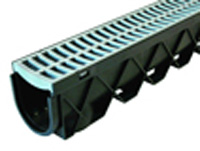
Picture from Polylok
An example of where a trench drain might be used is for patio drainage. A patio may be graded correctly at 1/4" per foot away from the house, but perhaps the lawn adjacent to it slopes towards the patio.
If the land cannot be graded away from the patio (or you don't want to re-grade the land away and disrupt your lawn), you can use this type of drainage pipe.
The top of the drain, (which is the grate) is installed level with the hardscape so that water can enter. It is usually not that wide. You can also choose a finish close in color to the hardscape color so that it blends in.
These drains can be used in many other landscape places
too, such as driveways, garage entries (where driveway meets the
garage), walkways, etc. where water cannot be pitched away.
Driveway Drainage
This type of drain works particularly well as a driveway drain at the garage entry when a driveway is pitched towards the house.
- The drain can be installed just outside the garage doors parallel to them.
- It must be pitched in one direction, lengthwise, for the water to flow.
- The drain can then connect to a solid pipe which is typically led underground to another location to exit.
- The solid pipe must be pitched also, so existing elevations of the starting and ending points must be calculated to make sure there is enough pitch.
Whereas perforated pipe must be wrapped in filter fabric and hidden beneath the ground, trench drains can be exposed. Therefore they work well with hardscapes. They come in various lengths and widths and are available in recycled plastics.
Check the different available colors. You don't want the drain to really be obvious. Ideally it should blend in with the hardscape so it is barely noticeable. Any necessary drainage should be addressed while a design is being done. Otherwise, you might be stuck with drainage problems that have to be remedied.
Another example would be if you had pool paving adjacent to your house. Pool paving must be pitched away from the pool itself. If the pool decking is next to your house or a retaining wall is there, water has nowhere to go. This type of grated drain pipe would be perfect for this situation.
Related PagesLawn Drainage
Driveway Drainage
Perforated Pipe
If you enjoyed this page, please share it!
Return From Trench Drains to Landscape Grading
Landscape Design Advice