Home
Find a Landscaper
Ebooks Front Yard Design
Landscaping Costs
Patio Design
Evergreen Shrubs
Design Services Online Design
3D Landscapes
Services
Landscape Software
Pictures & Videos Landscape Pictures
Hardscape Design
Patio Pictures
Project Photos
Walkways Pictures
Swimming Pool Pics
Waterfall Pictures
Hardscapes Patio Designs
Driveway Designs
Walkway Designs
Retaining Walls
Seat Walls
Landscape Steps
Deck Ideas
Paving Materials Paving Costs
Landscaping Cost
Concrete Designs
Pavers
Brick
Travertine Pavers
Bluestone Patios
Design With Stone
Water Swimming Pools
Waterfall Designs
Water Features
Design Ideas Landscaping Slopes
Front Yard Design
Backyard Landscape
Inexpensive Ideas
Landscaping Ideas
How To Landscape
Drawings and Ideas
Design Degrees
Landscape Grading
Garden Features Landscape Structures
Outdoor Furniture
Fire Pits
Pergolas
Fountains
Outdoor Kitchens
Bird Feeders
Fencing
Landscape Lighting
Go Shopping
Plants Landscape Plants
Landscape Trees
Hydrangea
Rose Bushes
Perennial Flowers
Flower Gardens
Flowering Vines
Xeriscape Plants
Other Info The Landscape Blog
Search
Privacy Policy
Share This Site
Advertise
Newsletter Sign Up
Contractor's Place
Blog
Site Index
Ask A Question!
About Me
About This Site
Contact Me
[?] Subscribe To This Site

XML RSS
Add to Google
Add to My Yahoo!
Add to My MSN
Subscribe with Bloglines

Retaining Wall For Small Ravaged Yard
retaining wall designs

retaining wall designs

This is a retaining wall question regarding heights and design.

I have a small yard in a cookie-cutter subdivision. But, it has a large hill encompassing 3/4 of it. There is maybe 8-10 ft. of semi-level yard before the slope begins. The yard is about 40ft wide by about 60 or 70ft deep.

My thought was to do one large wall across the yard about 5 feet tall. This way I can have a couple of fruit trees and garden up top - safe from dogs and kids. But, the landscaper that came out has recommended (2) 3ft. walls in a curved terrace form.

I think that would work. But I just can't seem to picture it or let go of my destruction-proof garden. I am in Ky, so the dirt is clay and there are drainage issues in my lower yard. I just don't know what to or where to find good resources on this. Thank you.

Naomi

ANSWER

Hi Naomi,
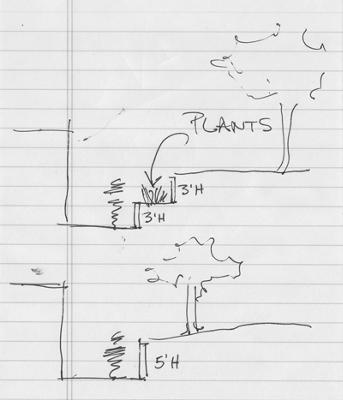
A five foot high wall is quite high, while (2) 3 foot walls are not so massive. However, the advantage of one wall, is that you are creating one large level area (behind the wall). Two walls create more of a terraced look, and you are also involved with a specific planting design between the walls...plus more maintenance of the garden.

I did a quick sketch for you showing the differences between using one or two retaining walls. It is not to scale, but shows the different wall scenarios. The scribbly item is a person showing general height relationships.


Note that the five foot wall provides a larger space on the upper level.

A five foot wall should be engineered and is more complicated to build as it is a much taller structure. In addition, you have to be sure to have either fencing on top or very deep planting beds to prevent anyone from falling over the wall. This is usually required by the township or city.

The best thing would be for it to be drawn out for you, to scale based on your property elevations and dimensions. This can be an elevation drawing like I did, but more accurate...even with the plants shown. Also, probably a drawing of curved walls in plan view as the alternative would be helpful.

The drainage issues in the lower section of your yard should also be addressed by your landscaper. Ask him how he is going to solve this problem. It might be a swale, a lawn drain, etc. It's possible that when the retaining wall is done, it will help, but this should be determined ahead of time by knowing the "after elevations" and where the water will drain to.

Btw, if you send me certain site info, I can do an accurate elevation for you. Otherwise I hope this info has been helpful!

Susan

Comments for
Retaining Wall For Small Ravaged Yard

Click here to add your own comments

Landscape Retaining Wall Sizes and Drains
by: Susan

Thanks for your comment. I tend to agree that typcially two lower retaining walls are better than one.

Another option would be to create two smaller walls and space them quite far apart...rather than terracing the area.

Naomi mentioned that the property is flat for 8 to 10 feet and then extends back for another 60 to 70 feet. So there are a few options.

One ideas would be to leave the 8 to 10' area alone and create the first 3' high retaining wall at the start of the slope. Then, instead of creating a small terraced bed of about 3' deep, the area above the wall could be quite deep...say about 20 to 30'. The second wall could then have another nice large area behind it of about 30 to 40'.

Or...the 8 to 10' flat area could be extended , creating a larger level are near the house.

Areas between the walls could be relatively flat, or they could have a slight slope to them.

Drainage pipe should be installed behind the wall(s). You can read more about that here:

Retaining Wall Drainage

It was mentioned that the level area near the house had a drainage problem. Here is where a swale could be created, or else a lawn drain with the land pitched towards the drain. Lower down in the drain would be a pipe that would lead the water away.

After saying all of this, sometimes a large wall can create a real feeling of enclosure. I can see lots of plants up against it, along with perhaps even a water feature.

Susan

Retaining Wall
by: James Comiskey

I would agree with dividing the slope with two walls. From a visual point of view it would look less harsh than one big wall. The two flat surfaces can be planted up to hide the walls even more. You might even have enough room to plant your fruit trees here but you shuld discuss this with your landscaper.
As mentioned you need to take safety into account, 5ft is a long way to fall. And as also mentioned less engineering would be required with two walls. You should also discuss the economics of both options with your landscaper.
As for the drainage I would imagine you need land drains behind the wall, but I have never carried out any projects in your area so discuss with your landscaper. A grass swale or a depression in the hard surface beside the wall may a good option for the drainage on the lower surface.

Click here to add your own comments

Join in and write your own page! It's easy to do. How?
Simply click here to return to Landscape Design Questions & Answers