Which Are the Best Evergreen Trees?
Evergreen trees are not only stately and beautiful, but also can be used for specific purposes in landscape design.
As their name implies, they are evergreen, meaning they will keep their leaves throughout the winter. This provides your landscape with winter interest. Although there are some smaller ones, most get quite large.
Since
there are different types of evergreen trees for different purposes,
here is a list of my recommended ones with information and with tips on
how to use them in your landscape.
Evergreen trees work well for the following purposes:
- screen your property and create privacy - you may want some of the fast growing evergreen trees listed below
- used at house corners, if they are pulled out far enough from the house to allow for the mature size. When used this way, they frame the home and also provide weight and strength
- provide evergreen color during the winter...they look great in the snow
On thing to remember about evergreens is that they look pretty much the same all year long! No flowers, no fall color...but they ARE evergreen.
Some of My Favorite Evergreens
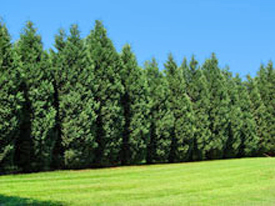
Leyland Cypress Evergreen Trees
If you are looking for trees for privacy, Leyland Cypress trees are excellent.
These are very fast growing evergreen trees and great for screening. You will achieve the privacy desired much faster than other trees, such as Norway Spruce.
It grows in full sun, which means at least 4 hours of sun a day.
Green Giant Arborvitae grows extremely fast, making a a perfect solution for creating privacy.
All year round screening is achieved since these trees are evergreen.
They are wind, ice and snow resistant...more so than other Arborvitae.
They
will get to be about 40 feet tall over time. Although they can get 15
feet wide, plant them closer for maximum screening. Five feet apart
should be fine...they will adapt nicely.
- The Norway Spruce is very beautiful with dark green needles and has pendulous branches as it ages.
- This is a deer resistant evergreen tree,thus a good choice if you have a deer problem.
- For property screening, it is one of the best.
Note: Norway Spruce can get huge. However,
if you use them in a line along your property border (whether staggered
or a straight line), do not be afraid to plant them close to each
other. They will adapt to the space that they have.
As an example, plant
them 10 feet apart. The trees will be fine and you will get faster (or
instant, depending on the size of the tree) privacy!
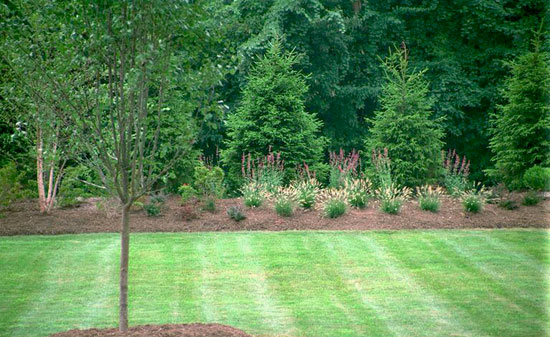
The trees shown here are Norway Spruce and were
used for privacy, to block noise from the road, and also as something
pretty to look at from the house.
Blue Spruce
- I occasionally like to use this tree together with Norway Spruce.
- The Blue Spruce is a very pretty blue-green color.
- It is slightly stiffer than the Norway Spruce.
If you were creating privacy with landscape trees at the border of your property, you might consider using some Norway Spruce and one Blue Spruce.
When doing this, start with a few Norway Spruce.
Then add a Blue Spruce and continue with some more Norway Spruce. They
should be an accent, not overtake the landscape due to the blue color.
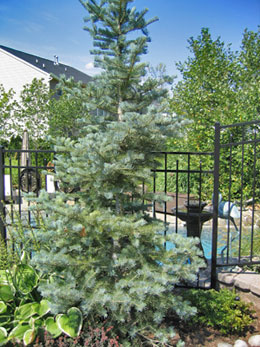
Douglas Fir
- This tree is similar to Norway Spruce, except that the needles are softer.
- I've used these on many of my projects and they create a great specimen or screening for privacy. Place them about 10 to 15 feet apart for privacy...don't worry, even though they get wider, they will adapt.
- If
you are screening a very long area, consider mixing together groups of
Norway Spruce, Douglas Fir, and one or two Blue Spruce mixed in.
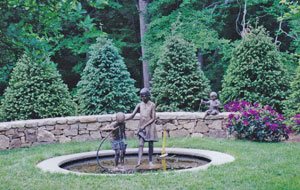
Cryptomeria
- Cryptomeria, or Japanese Cedar, tends to be a little bit more ornamental in nature.
- The branching of this beautiful tree is slightly weeping in form.
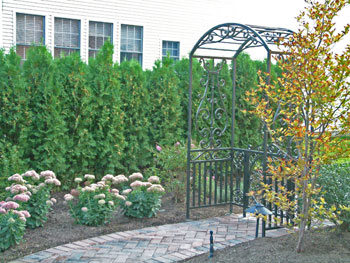
- This tree should be used alone as a focal point or at the corner of a house (although the photo shows them as a hedge...not the best use of them in my opinion...they are too ornamental for that purpose).
- Cryptomeria
is much narrower than Norway Spruce or Douglas Fir and thus easier to
use near the house in many residential landscapes.
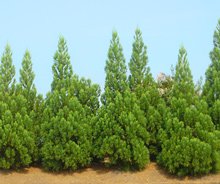
Note: If you have the space, consider placing an ornamental tree, evergreen shrubs, flowering shrubs and perennial flowers in front an evergreen border. Not only will this add lots more interesting plants to look at, but they will really stand out with the dark, evergreen background.
American Holly Tree
- The leaves are different than the others since their leaves are broad leaved and serrated.
- The females produce colorful red berries in abundance for winter interest.
- This tree will take much more shade than any of the others mentioned.
This is one of my favorite evergreen trees!
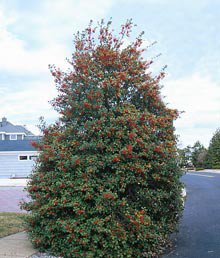
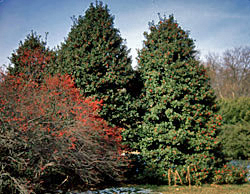
Photo From Rutgers Gardens
In this photo , you can see the American Hollies in the back, although it's hard to make out the beautiful berries that they produce. Next to the Hollies, towards the left, is a Winterberry Holly. This large shrub is not evergreen, but the red berries are outstanding.
The photo above clearly shows the wonderful berries produced by this evergreen tree.
When
I was at Rutgers University getting my degree in Landscape
Architecture, I often visited Rutgers Gardens which had a magnificent
display of American Hollies, planted by Dr.Orton many years prior.
Although American Hollies are known to do well with some shade, those at
Rutgers Gardens were planted in full sun and were breathtaking.
Note: There is nothing worse than having your evergreen trees
eaten by deer. If you don't have a deer problem...great! If you do, note
the following.
These evergreen trees are deer resistant.
Norway Spruce
Blue Spruce
American Holly
Green Giant Arborvitae - known to be resistant but not proven
Cryptomeria - seldom eaten, but sometimes
These evergreen trees are favored by deer: (Deer like them!)
Leyland Cypress
Douglas Fir
Nellie Stevens Holly
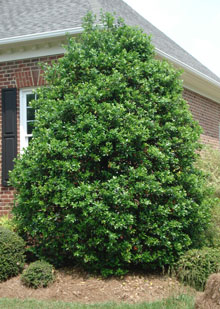
- This is a much narrower type of American Holly.
- It will get tall, but you can easily use it at house corners. It looks great there.
- Nellie Stevens Holly can be more easily incorporated into the residential landscape than American Holly because less space is required. However, you will need less of the American Holly if you are creating a hedge.
If
you use any type of holly in the landscape whether it be a tree or a
shrub, include one male. This is needed for the production of berries on
the female plants.
Wichita Blue Juniper
This blue evergreen tree is striking due to its color.
It stands out in the landscape as a focal point and as a change from all the other greenery. It has a nice pyramidal shape too.
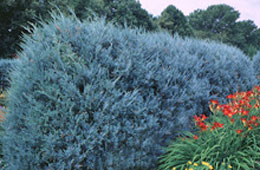
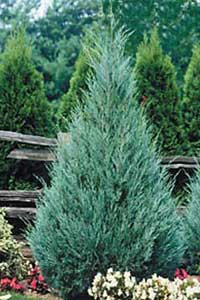
Photo from Flemings Lawn and Tree Service
If you are going to use this as a hedge, you might consider adding plants in front.The blue color will still be noticeable, but the entire landscape will be a more attractive blend.
This tree stays relatively narrow at about 4 to 6 feet wide which makes it a good choice for narrow areas. It will get to be about 10 to 15 feet tall.
The botanical name of Wichita Blue Juniper is Juniperus scopulorum and it is also known as Rocky Mountain Juniper or Colorado Redcedar.
There are other similar cultivars such as the following.
- Skyrocket - One of the most narrow.
- Moonglow - silver blue foliage and very broad
- Medora - nice blue-green foliage but a slower grower
Wichita Blue Juniper is a good choice if you are looking for the type of evergreen tree that gets large and has blue foliage.
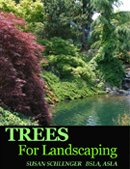
Click HERE to get my FREE ebook!
(55 pages of must have information when selecting trees)
If you enjoyed this page, please share it!