Laying Bluestone Over An Existing Concrete Base
by Paul Grassi
(Broomall, Pa.)
Is it ok to lay a blue stone patio on an existing concrete pad? If so what is the proper technique. Should i place a mortar bed and set or is there an exterior thin set that can be used?
ANSWER
Hi Paul,
You can set the bluestone on a concrete pad as long as the pad is in excellent condition. The concrete pad should be 4"-6" thick. Beneath the concrete there should be 6" compacted aggregate, laying on undisturbed or compacted soil.
I would then set the bluestone on a 1"-2" mortar setting bed.
Double check all of this with a qualified mason if you can. This information is taken from Timesaver Standards - cut or field stone detail for installation, wet laid.
And if you are looking for patio design ideas, please take a look at my ebook Patio Plans for Inspiration

Join in and write your own page! It's easy to do. How? Simply click here to return to A Question.
Bluestone Over Concrete
by Mr. B. Don
We have a roof covered patio on the back of our house, built c. 1950.
The floor consists of 3 sections of cement (with strips of wood in
between each ). There are also
cement stairs leading down to the basement entrance .
The mid section of the floor has a huge crack that has been there for years.
We would like to facelift the patio and are considering using bluestone.
A couple masons have suggested to lay the blue stone over the existing concrete patio.
What would you suggest?
Demolish/remove existing cement patio first?
Or would it be okay to bluestone on top without removing the cement?
We live in northern new jersey and have v. cold winters.
Thank you in advance for any advice you can offer.
B.Don
ANSWER
Hi,
I hate to go against what masons say, but if your patio has a crack, I would never lay bluestone over concrete in this situation.
It's difficult enough to do a proper job of laying bluestone in cement, especially in northern NJ (where I am from!).
This is what I would suggest.
Remove the existing concrete. This will be an added expense, but you can save money by dry-laying the new bluestone. Regardless of the costs differences between installing bluestone in concrete or dry-laying it, I would opt for the dry laid method anyway.
It IS less expensive, but beyond that, you will never have any problems with cracking. The bluestone pieces can be laid very close to each other, as close as 1/4 inch spacing. This spacing (or a little wider) can be filled with loose stone or else you can choose a polymeric sand, which hardens.
I rarely specify bluestone to be set in concrete, not that I don't like the look, but for the above reasons.
Take a look at this page.
https://www.landscape-design-advice.com/patio-designs.html
It shows an example of a bluestone patio, dry laid. The color of bluestone is called full range, where you get various colorations. You could also choose full blue, where the stones are all the same...blue.
I hope this was helpful. If you have further questions, just post back here under Comments.
Susan
Join in and write your own page! It's easy to do. How? Simply click here to return to A Question.
Cut Bluestone over concrete steps
by Tobi
(Palo Alto, CA)
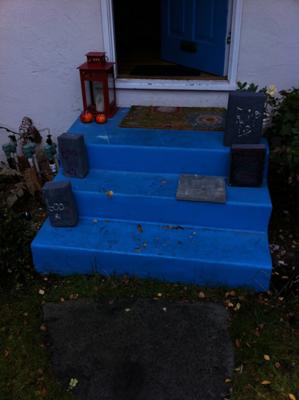
We have concrete steps at our house entrance (4 steps and a little bigger platform on top, total about 30 sq ft).
The steps are in great condition and have been painted by the previous owners with just regular outside paint. We want to change this to cut bluestones on top with stone veneer on the riser. Since this is a new project for me, I want to make sure that I do it right. Could you please let me know if the steps are correct or what else I should consider? We live in the San Francisco Area and don't really get big temperature changes.
1) remove paint (power washer?)
2) prepare surface (is the wash enough or do I need a sealer?)
4) put up veneer on risers (mortar or thin set?)
3) lay bluestone (mortar or thin set?)
ANSWER
Hi Tobi,
I am not a mason, so cannot answer your questions about construction. However, I know this can be done. I would check with the stone yard where you are purchasing the bluestone to get your answers.
I would like to mention though that you should think about elevations and heights when you do this. The bluestone, being 1" - 2" thick, will cause the finished elevations on your treads and the porch itself to be higher.
The porch should not be a problem as the step into the house does not have to match the heights of the steps. However, you should measure the heights of your risers. A comfortable height is 6" - 8", the lower the better. You could do 8 1/2" if you had to. So whatever the heights are now, add on the bluestone thickness (plus some mortar) to know the new heights.
If necessary, you can chisel down the existing concrete.
If it's in your budget, consider one large piece of bluestone for the treads. See the first picture on this page. Bluestone Steps. This type is a bit more expensive. Further down on the page you will see the treads done in bluestone pieces. The bluestone treads can be either regular bluestone or have a thermal edge, which looks rough and wavy...not my preference.
If you opt for separate pieces, make sure that the joints alternate and do not line up from step to step. You'll have to figure this out mathematically.
Click here to read or post comments
Join in and write your own page! It's easy to do. How? Simply click here to return to A Question.
Repair Bricks or Replace with Bluestone?
by Amy
(Albany, NY)
We just bought a home in Albany, NY with brick front steps that need to be repaired due to cold/weather damage. We are trying to decide whether to repair the brick or whether it's worth the additional cost ($1000) to replace them with bluestone (recommended by the masons.) What is your opinion?
ANSWER
Hi Amy,
Whether to repair the bricks or replace them with bluestone depends on your finances. You could probably repair them, although it most likely will not be a permanent solution. You might do that though to save some money now, and then when they fail again (I'm assuming they will), you could change them.
The reason they are not holding up is most likely due to the fact that they were not installed properly and the steps built the right way. It could be that your treads (the area you step on) or the risers ( vertical part of the steps) are the parts that have cracking joints. If it is the treads that are the problem, that is better, although it still could be coming from the bottom.
If it's the risers, then most likely the base beneath the steps was installed incorrectly. You didn't indicate which area was the problem (or both). If it's the risers, you would be better off re-building all the steps from scratch incuding the base.
Also, if you do replace the treads with bluestone, consider one large piece per tread. This way you won't have any concrete joints to repair in the future, just in case.
You can take a look at some bluestone treads and the different types here:
Bluestone Steps.
In a nutshell, make sure the porch and steps are built correctly to eliminate future problems if you are going with the bluestone.
Join in and write your own page! It's easy to do. How? Simply click here to return to A Question.
Bluestone on Concrete
by Michael
(Syosset, NY)
Can I have bluestone "dry laid" on a cement base?
I had planned to mortar the joints, but I do prefer the look of a dry lay and it would also resolve the problem of cracking mortar in the future (I live in the Northeast).
Thanks...and your site is awesome.
ANSWER
Hi Michael,
Glad you like my site!
Yes, you can do this. However, the existing concrete base must be in good condition...no cracks or settling.
You might consider using polymeric sand in the joints. It resembles regular sand used for dry laid applications, but hardens. When you think about it, this makes sense for stone applications over concrete, because it's better if the water does not percolate through the joints down to the concrete and sit there. The polymeric sand helps with this.
Also, be sure that your existing patio is pitched properly for drainage.
It would probably cost you about $800+ to just remove the concrete and start over again.
Take a look at this page with questions and answers on Laying Bluestone Over Concrete.
Another Bluestone Question
I had a dry lay natural bluestone patio installed 5 years ago; it needs redone due to settling. I think the wrong thickness of natural bluestone was used. The average thickness is approx one half to three quarter inch. The patio needs to be removed and reinstalled. Should I dry lay again or install a concrete pad. I live in western Pa. thx
ANSWER
Hi James,
The bluestone you have does seem rather thin. I would recommend starting all over again with a thicker bluestone (1" to 2") and dry lay the patio due to the following.
1. It will be less expensive to do this compared to wet laying it. Much of the cost is in the installation. You will pay approximately $20/sf for a dry laid application including materials (thicker bluestone). Wet laid costs 3 times that or more including the bluestone. It will still be more even without the cost of materials (if you use your existing stone).
2. If you wet lay it, there is always the chance of the concrete joints cracking.
In addition, make sure the patio slopes away from your house at a minimum of 2%, or 1/4" per foot to alleviate any drainage issues in your basement. If you can't do this (sometimes you just can't), consider laying a perforated pipe along your house foundation for drainage. See my page on perforated pipe.
If you want to change the design of your patio or just get some great ideas for interest, such as seat walls, see my ebook Patio Plans for Inspiration.
Regards,
Susan
Join in and write your own page! It's easy to do. How? Simply click here to return to A Question.

If you enjoyed this page, please share it!